
Why Every Leader Needs a Functional Development Plan
10 MAR 2026 / Why Every Leader Needs A Functional Development Plan
(by Sven Vogelgesang)
As a leader, do you have a strategic development plan for your entire department?
From Strategy to Action: Why Every Leader Needs a Functional Development Plan
But here is the critical question for leadership: Do you have a development plan for your department as a whole?
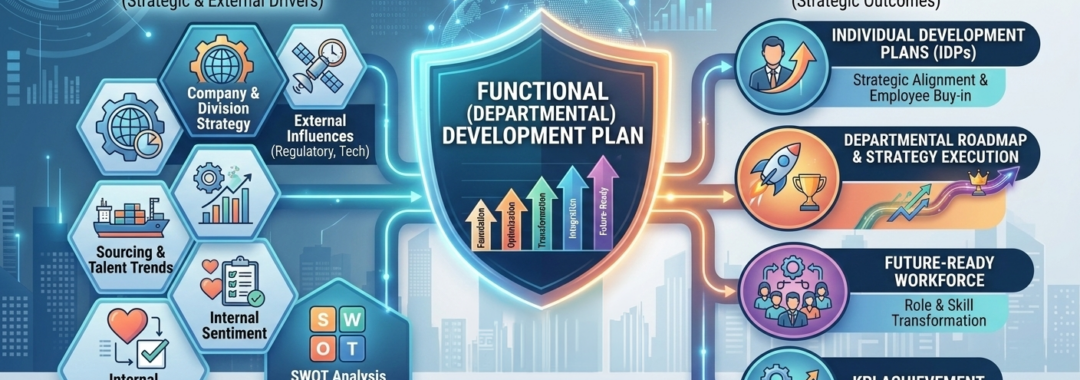
Individual growth is essential, but without a Functional Development Plan (FDP), you are developing people in a vacuum. An FDP is the missing link—it translates high-level corporate strategy into a concrete roadmap for your team’s collective evolution.
The Foundation: What Drives a Functional Development Plan?

To build a future-ready department, you must look beyond your current “To-Do” list. An effective FDP is fueled by key inputs:
- Macro Strategy: The overarching goals of the company and your specific division.
- External Landscape: Shifting regulatory requirements, technological breakthroughs, and industry trends.
- Sourcing & Talent Trends: Availability of skills in the market and changes in how work is outsourced or automated.
- Internal Sentiment: Data from engagement surveys and culture audits.
- SWOT Analysis: A rigorous look at your department’s current strengths, weaknesses, opportunities, and threats.
Mapping the Future: The 5-Year Roadmap
With these inputs, you can define your department’s destination. Ask yourself: Where must we be in five years to remain relevant? This isn’t just about doing more work; it’s about evolution. You must determine which technologies will be required, how current roles will transform, and which roles might become obsolete. Most importantly, you must ask: Does our department even need to exist in its current form?

The Functional Development Plan: Role & Skill Assessment Framework
To bridge the gap between today and your 5-year vision, use this structured assessment:
- Current Roles (“Evolution”): Identify current roles and compare skills needed today vs. tomorrow (e.g., a Data Analyst moving from SAS to AI-driven modeling).
- New Roles (“Innovation”): Define entirely new positions required to meet future technological or strategic demands. What skills are needed for these new roles?
- GAP Analysis (“The Needs”): Identify the delta between current capabilities and future needs. For Roles this becomes the primary input for your team’s IDPs. It is a good exercise to go through these skills and each employee with your management team. Also good for a discussion with the employees, which helps to get buy in and an understanding why roles change and what chances are there for them. For technology this will e.g. result in implementation projects.
- Implementation (Execution): Create an implementation plan with clear accountabilities, specific owners, deadlines, and milestones.

Turning Plans into People Power
The Gap Analysis is where the magic happens for People Leaders. By discussing these future skill needs with your management team and employees, you achieve two things:
- Strategic Alignment: Employees understand why their roles are changing, reducing resistance to new technology.
- Buy-in: When an employee sees how their personal training (IDP) fits into the department’s roadmap (FDP) and success, they are more engaged.
Measuring Success
A plan without metrics is just a wish list. Integrate your FDP with Departmental KPIs. If your plan is e.g. to automate 50% of manual reporting, your KPIs should reflect increased efficiency, reduced error rates, or shifted man-hours toward strategic analysis.

The Bottom Line: An Individual Development Plan grows a person; a Functional Development Plan grows an organization. Review this plan and the implementation regularly to ensure your team isn’t just working hard, but working toward the right future.
One of our Consulting Service Offer is to support you as a leader to define a Functional/Departmental Development Plan for your department/function incl. an implementation plan. A Functional Development Plan translates high-level corporate strategy into a concrete roadmap for your team’s collective evolution.